The arrival of a new year often brings a sense of fresh beginnings, and in 2026, the night sky is ready to celebrate right along with us. If you are looking at the 1 janjanuary 2026 moon calendar, you are in for a celestial treat that starts almost immediately.
The lunar cycle is more than just a changing shape in the sky. For students, it is a lesson in orbital mechanics. For gardeners, it is a guide for planting. For the rest of us, it is a beautiful reminder of our place in the solar system.
January 2026 is particularly special because it features a “Supermoon” to kick things off. This means the Moon will be at its closest point to Earth while also being fully illuminated, making it look larger and brighter than your average full moon.
In this guide, we will break down everything you need to know about the 1 janjanuary 2026 moon calendar. We will cover the specific dates for every phase, explain the significance of the Wolf Moon, and even look ahead at how this connects to other months like the october moon calendar.
The Major Moon Phases of January 2026
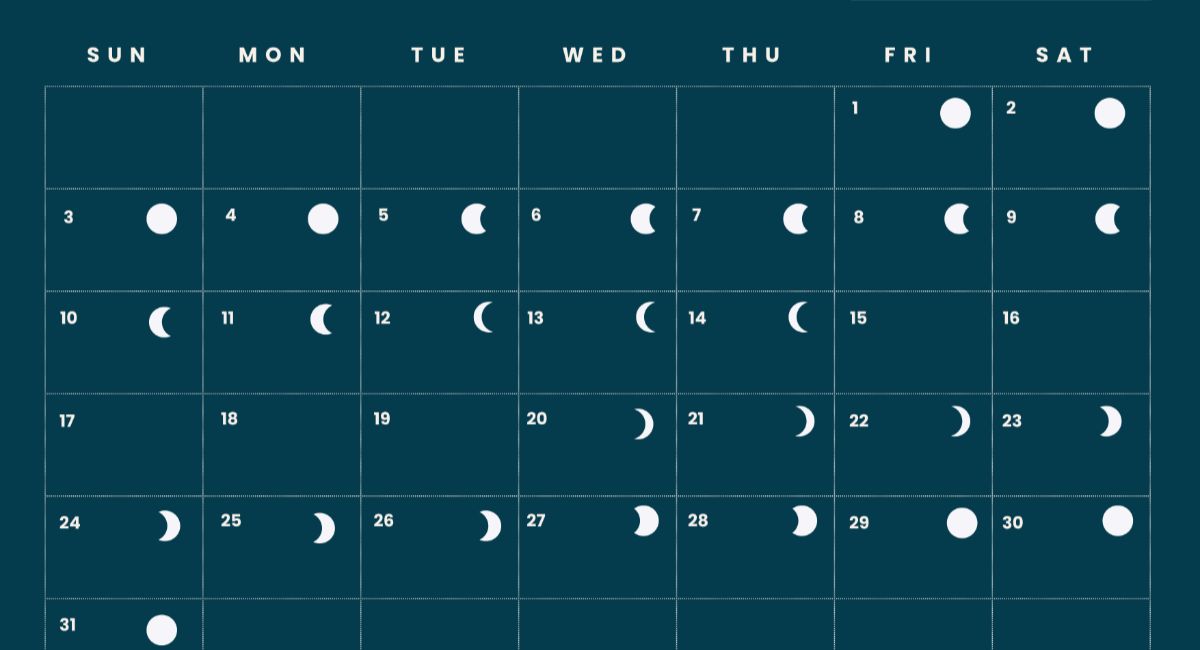
To use a 1 janjanuary 2026 moon calendar effectively, you first need to know the four primary phases. These are the “anchor points” of the lunar month.
Full Wolf Moon (Supermoon): January 3, 2026
The first full moon of the year occurs very early. Reaching peak illumination at approximately 10:02 UTC on January 3, this is the famous “Wolf Moon.” Because it is a supermoon, it will be one of the most photographed events of the season.
Last Quarter Moon: January 10, 2026
By January 10, the Moon will have moved three-quarters of the way through its orbit. You will see exactly half of the Moon illuminated in the early morning sky. This is a great time for observers because the shadows on the Moon’s surface make craters look deep and detailed.
New Moon: January 18, 2026
On January 18, the Moon sits between the Earth and the Sun. Its dark side faces us, making it invisible to the naked eye. This is the best night for “deep sky” stargazing because there is no moonlight to wash out the faint glow of distant galaxies and star clusters.
First Quarter Moon: January 26, 2026
As the month draws to a close, the Moon returns to a half-lit state on January 26. This phase is visible in the afternoon and evening, hanging high in the sky as the sun sets.
Why the 1 Janjanuary 2026 Moon Calendar is Special
The start of 2026 is unique because of the proximity of the Moon to Earth. The term “Supermoon” refers to a Full Moon that happens near “perigee,” which is the point in the Moon’s elliptical orbit where it is closest to our planet.
During the January 3 Full Moon, the Moon will be roughly 362,312 kilometers away. While that sounds like a long distance, it is close enough to make the lunar disk appear 14 percent larger and 30 percent brighter than a “Micromoon” (when it is at its farthest point).
Additionally, this month features several “conjunctions.” This is when the Moon appears very close to a planet in our sky. On January 3, the Supermoon will be nestled near Jupiter, the largest planet in our solar system. This creates a stunning “double act” for anyone looking up that evening.
Best Remote Part Time Jobs for College Students
While tracking the 1 janjanuary 2026 moon calendar is a hobby for many, for college students, it might represent a moment of downtime between classes and work. If you are a student looking for remote part time jobs that allow you enough flexibility to enjoy the night sky, here are some top options.
Virtual Assistant
Many small business owners need help with emails, scheduling, and basic data entry. This role is almost entirely remote and often allows you to set your own hours, making it perfect for balancing a heavy course load.
Online Tutor
If you excel in math, science, or English, you can help younger students via video call. Sites like Chegg or Tutor.com allow you to log in whenever you have free time, providing a steady stream of income without a commute.
Freelance Content Writer
Writing blog posts or social media captions is a great way to build a portfolio. You can write about topics you love, like astronomy or technology, and work from the comfort of your dorm or a local coffee shop.
Social Media Moderator
Many companies need people to monitor their comment sections and engage with followers. This usually requires a few hours a day and can be done from a phone or laptop at any time.
Connect
Staying connected with the astronomical community is the best way to keep your 1 janjanuary 2026 moon calendar updated. Lunar cycles are predictable, but weather and local visibility are not.
You can join local astronomy clubs or online forums where members share real-time photos of the lunar surface. Engaging with these communities helps you learn the best “dark sky” spots in your area, away from city light pollution.
Social media platforms are also excellent for following professional observatories. They often post alerts when the Moon is about to pass in front of a star or when a meteor shower is peaking alongside a specific moon phase.
Resources
To get the most out of your 1 janjanuary 2026 moon calendar, you should utilize a few key resources. Digital tools have made it easier than ever to be a “backyard astronomer.”
- MoonCalc.org: This is a highly accurate tool for calculating the exact position of the Moon based on your specific latitude and longitude.
- Star Walk or SkyView Apps: These mobile apps allow you to point your phone at the sky to identify planets, stars, and the Moon’s current path.
- The Old Farmer’s Almanac: A classic resource for traditional moon names and gardening by the moon cycles.
- NASA’s Lunar Portal: For the most scientific data, NASA provides high-resolution imagery and updates on upcoming lunar missions like Artemis II.
Information For
The 1 janjanuary 2026 moon calendar provides different values depending on who you are and what your goals are for the month.
For Students and Educators
The January 2026 cycle is a perfect case study for learning about “perigee” and “apogee.” You can track the Moon’s distance over the 29.5-day cycle to see how its apparent size changes.
For Photographers
The Supermoon on January 3 is your best opportunity for “Moon Illusion” shots. This is when you photograph the Moon next to buildings or trees on the horizon, making it look massive.
For Gardeners
Many people follow the tradition of planting “above-ground” crops during the waxing phases (from New Moon to Full Moon) and “below-ground” crops during the waning phases. In January, the best days for planting leafy greens would be between January 20 and January 31.
For General Skywatchers
If you simply enjoy the beauty of the night sky, mark January 18 on your calendar. With no moonlight to interfere, it is the perfect night to take a drive away from the city and look at the Milky Way.
Comparison: January vs. October Moon Calendar
It is often helpful to look ahead to see how the lunar cycle evolves throughout the year. When we compare the 1 janjanuary 2026 moon calendar to the october moon calendar, we see some interesting patterns.
The october moon calendar for 2026 features the “Hunter’s Moon.” By this time of year, the Moon’s path across the sky is different because of the Earth’s tilt. In October, the Full Moon occurs on the 26th, much later in the month than the January Full Moon.
Tracking these differences helps you understand why the Moon appears higher or lower in the sky depending on the season. While January offers crisp, clear winter views, October provides the classic “Harvest Moon” atmosphere that many find nostalgic.
Detailed Lunar Schedule for January 2026
If you are planning an event or a photography session, you need specific dates. Here is the day by day breakdown of the 1 janjanuary 2026 moon calendar.
| Date | Moon Phase | Illumination | Significance |
| Jan 1 | Waxing Gibbous | 93% | Near Aldebaran star |
| Jan 3 | Full Moon | 100% | Wolf Moon / Supermoon |
| Jan 10 | Last Quarter | 50% | High detail in craters |
| Jan 18 | New Moon | 0% | Best for stargazing |
| Jan 26 | First Quarter | 50% | Visible in the afternoon |
| Jan 31 | Waxing Gibbous | 98% | Near Jupiter again |
Practical Takeaways for Your Lunar Journey
Using a 1 janjanuary 2026 moon calendar is simple once you have the right mindset. Here are a few actionable tips to make your viewing experience better.
First, always check the moonrise times. The Moon looks its largest when it is near the horizon. This is due to an optical illusion where our brains compare the Moon to familiar objects like houses or trees.
Second, dress for the weather. January nights are cold, and you will enjoy the view much more if you are wearing layers. Since the best views often happen late at night or early in the morning, comfort is key.
Third, use binoculars if you have them. You don’t need an expensive telescope to see the “Seas” of the Moon (the dark, flat volcanic plains) or the bright rays of the Tycho crater.
Conclusion
The 1 janjanuary 2026 moon calendar is your roadmap to a spectacular start to the year. From the massive Wolf Supermoon on the 3rd to the inky dark skies of the New Moon on the 18th, there is something for everyone to enjoy.
By understanding these phases, you connect with a cycle that has guided humanity for thousands of years. Whether you are a student learning the ropes of astronomy or a busy worker looking for a moment of peace, the Moon is always there, changing yet constant.
Take a moment this January to step outside, look up, and appreciate the silent dance of our nearest celestial neighbor. It is a free show that never fails to impress.
Footer – Main
Thank you for visiting our lunar resource center. We are dedicated to providing the most accurate and easy to understand astronomical content for readers of all levels. Whether you are tracking the 1 janjanuary 2026 moon calendar or looking ahead to the october moon calendar, we have the guides you need