The Magic and Mechanics of Moonrise Time: Your Essential Lunar Schedule Guide
Have you ever looked up at the sky, seen the magnificent disk of the Moon hanging low on the horizon, and wondered, “When did that get there?”
The moment the Moon officially crests the eastern horizon—that is the moonrise time. It’s a moment of quiet, ancient magic, a daily celestial event that connects us to the grand rhythm of the cosmos.
But unlike the sunrise and sunset, which follow a highly predictable schedule, the moonrise time is a little more complicated. It’s a wanderer, arriving at a different moment each day.
Why does the Moon’s schedule feel so random? How can you predict exactly when our celestial neighbor will make its grand entrance? And what is the practical purpose of knowing this precise moment?
As your friendly Lunar Content Strategist, I’m here to demystify the celestial mechanics. This comprehensive guide will turn you from a casual sky-gazer into a master of the lunar schedule. You’ll learn the science behind the varying moonrise time, understand its unbreakable link to the Moon’s phases, and discover the best tools to help you plan your next perfect evening under the rising moonlight.
Ready to synchronize your life with the beat of the Moon? Let’s launch into the science of the moonrise time.
The Daily Shuffle: Why Moonrise Time Never Stays the Same
If the Sun is the Earth’s dependable clock, the Moon is its beautiful, slightly erratic dancer. The time the Sun rises and sets only shifts by a few minutes from day to day, following a smooth, annual arc. The Moon, however, is constantly shuffling its schedule.
This is the single biggest question people have about lunar timing: Why does the moonrise time occur nearly an hour later each day?
The answer lies in the dynamic, three-body ballet performed by the Sun, the Earth, and the Moon.
The Phenomenon of the 50-Minute Delay
“On average, the Moon rises approximately 50 minutes later each day compared to the previous day.”.
To understand this, you must look at two primary motions happening simultaneously:
- Earth’s Rotation: The Earth spins on its axis once every 24 hours, which is what causes the Sun, Moon, and stars to appear to “rise” in the east and “set” in the west. This is the main force behind our daily calendar.
- Moon’s Orbit: While the Earth is spinning, the Moon is also moving in its own orbit around the Earth. The Moon takes approximately 27.3 days to complete one full orbit around our planet.
During the time it takes the Earth to make one full 24-hour rotation, the Moon has not stood still. It has continued to advance eastward along its orbital path.
In that 24-hour period, the Moon moves about 13 degrees in its orbit. For you to see the Moon rise again, the Earth has to rotate an extra 13 degrees to “catch up” to the Moon’s new position.
It takes the Earth approximately 50 minutes to rotate those extra 13 degrees. This extra rotation time is the average daily delay we observe in the moonrise time.
The Great Variation: Why the 50 Minutes Isn’t Exact
If the delay was always exactly 50 minutes, tracking the Moon would be much simpler. But as seasoned sky-gazers know, the shift can sometimes be as little as 15 minutes, or as much as 80 minutes (over an hour!) from one night to the next.
This variation is caused by three complex celestial factors:
1. The Tilt of the Moon’s Orbit
The Moon does not orbit the Earth along the same plane as the Earth’s equator. Instead, the Moon’s orbital path is tilted by about 5 degrees relative to the Earth’s orbital plane around the Sun (the Ecliptic).
The angle at which the Moon’s tilted path intersects the horizon changes throughout the month.
- When the Moon is moving at a steep angle relative to the horizon, it dips significantly below the horizon from one day to the next. The Earth has to rotate much farther to bring it back into view, resulting in a long delay (sometimes over an hour).
- When the Moon is moving at a shallow angle relative to the horizon, it doesn’t dip as far below the horizon. The Earth doesn’t have to rotate as much, resulting in a short delay (sometimes only 15 to 20 minutes).
This effect is most pronounced near the Full Moon during the autumn months in the Northern Hemisphere, leading to the famous “Harvest Moon,” which seems to rise around the same time for several nights in a row.
.
3. Your Latitude (Where You Are on Earth)
The final key factor is your geographic location. The effect of the Moon’s orbital tilt (Factor 1) is dramatically amplified the farther you move from the equator.
- Near the Equator: Observers experience the most consistent, smaller daily shifts in moonrise time.
- Near the Poles (High Latitudes): Observers experience the most extreme variations, sometimes seeing the moonrise delay jump from 30 minutes to 70 minutes over just a few days.
This complex interplay of tilt, speed, and location is what makes predicting the Moon’s daily arrival such a wonderfully intricate science, and why we rely on sophisticated calculators to get the precise minute.
The Moon Phase Connection: A Simple Rule of Thumb
While the precise minute of moonrise time requires a calculator, the Moon’s phase offers a highly dependable, easy-to-remember rule of thumb for its approximate rise and set times.
The key to this simple prediction system is to understand the angular distance between the Sun and the Moon, which is what determines the phase we see.
The Moon completes its cycle of phases every 29.5 days (a synodic month). During this cycle, its relationship to the Sun’s position in the sky—and thus the Sun’s rise and set times—creates four cornerstone moments that are easy to remember.
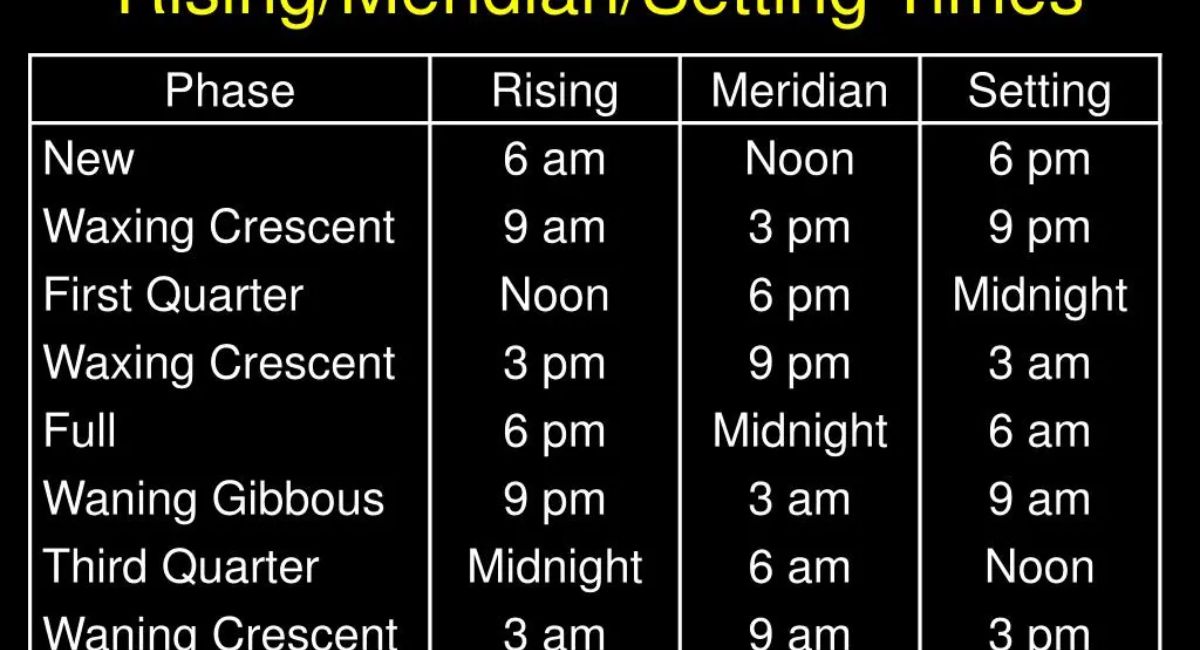
1. New Moon: Rises with the Sun
- Phase Appearance: Invisible or nearly invisible. The illuminated side faces away from Earth.
- Moonrise Time: Approximately Sunrise (6:00 AM).
- Set Time: Approximately Sunset (6:00 PM).
- Why it works: In this phase, the Moon is almost exactly between the Earth and the Sun. From our perspective, the Moon is in the same part of the sky as the Sun. Since they travel together, they rise and set at roughly the same time. This is why a New Moon is never seen at night.
2. First Quarter Moon: Rises at Noon
- Phase Appearance: Exactly half-illuminated (the right side in the Northern Hemisphere, left in the Southern Hemisphere).
- Moonrise Time: Approximately Local Noon (12:00 PM).
- Set Time: Approximately Local Midnight (12:00 AM).
- Why it works: The First Quarter Moon is about 90 degrees away from the Sun in the sky. If the Sun is at its highest point (noon), the Moon must have just risen on the eastern horizon.
3. Full Moon: Rises at Sunset
- Phase Appearance: Fully illuminated, appearing as a perfect, bright disk.
- Moonrise Time: Approximately Sunset (6:00 PM).
- Set Time: Approximately Sunrise (6:00 AM).
- Why it works: The Earth is nearly between the Sun and the Moon. The Moon is now 180 degrees away from the Sun in the sky. As the Sun disappears below the western horizon, the Full Moon makes its spectacular appearance on the eastern horizon. This is why a Full Moon is visible all night long.
4. Last Quarter Moon: Rises at Midnight
- Phase Appearance: Exactly half-illuminated (the left side in the Northern Hemisphere, right in the Southern Hemisphere).
- Moonrise Time: Approximately Local Midnight (12:00 AM).
- Set Time: Approximately Local Noon (12:00 PM).
- Why it works: The Last Quarter Moon is 270 degrees away from the Sun (or 90 degrees behind the Sun). As the Earth turns to midnight, the Moon crests the eastern horizon. Like the New Moon, it’s mostly a daytime Moon, though it rises right as the night begins to wane.
The moonrise time is most closely linked to the Moon’s phase. The Full Moon rises at approximately Sunset, the New Moon rises at Sunrise, the First Quarter Moon rises around Local Noon, and the Last Quarter Moon rises around Local Midnight. This pattern occurs because the Moon’s phase is determined by its angular separation from the Sun, and a full cycle of rise and set times corresponds to the Moon’s 29.5-day orbit around the Earth.
Finding the Precise Moonrise Time Today: Your Digital Lunar Calculator
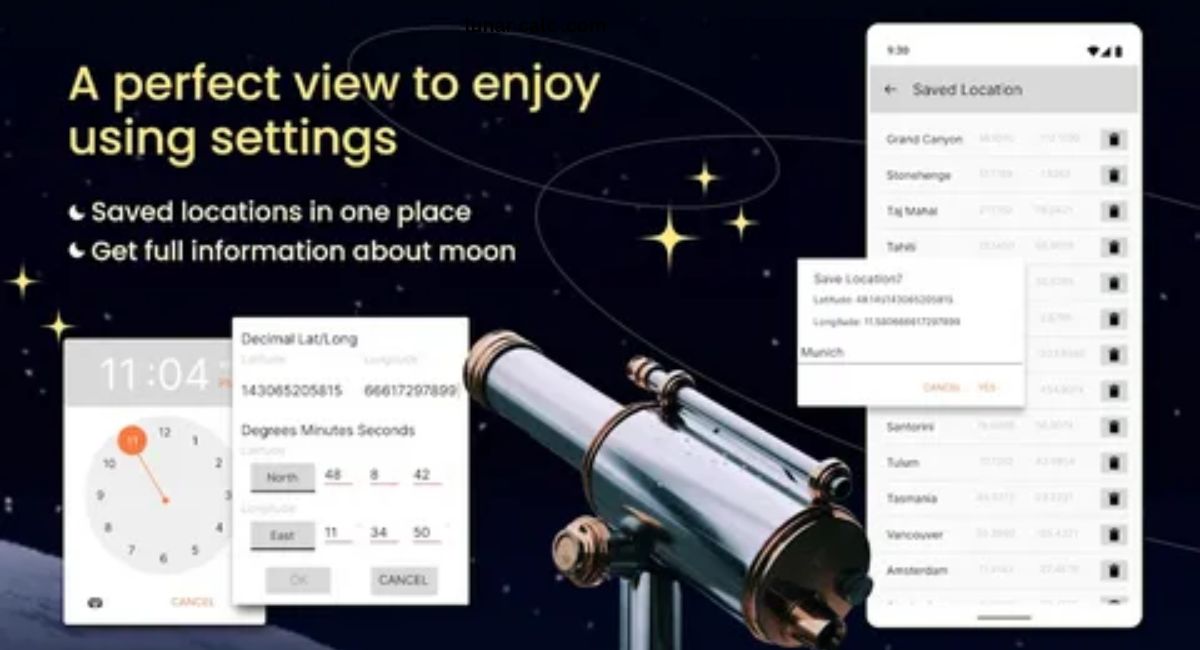
While the rule of thumb based on phases is great for general planning, modern life—and modern photography—often demands precision. Due to the factors we discussed (orbital tilt, ellipse, and your specific latitude/longitude), the exact minute of moonrise time for a single location requires complex astronomical calculations.
Fortunately, you don’t need a supercomputer or a degree in celestial mechanics to get this data. You just need a digital tool, which essentially acts as your personal “lunar calculator.”
The Data You Need for Pinpoint Accuracy
Any reliable tool needs the following data points to calculate the moonrise time for your location:
- Latitude and Longitude: This is the most critical factor. Your position on Earth determines when the Moon’s path crosses your local horizon. Many apps and websites automatically get this from your device’s location services.
- Date: The Moon’s position changes every single moment, so the date is essential.
- Elevation (Optional but Helpful): If you are on a mountain or cliff, you will see the Moon rise slightly earlier than someone at sea level. High-end tools sometimes allow for this correction.
- Time Zone: The result must be converted to your local time.
The Best Tools for Finding Moonrise Time
There are several excellent, user-friendly resources available today that serve as accurate lunar calculators.
1. Specialized Astronomy Apps
Apps are arguably the most convenient, especially for people on the move, like photographers or hikers.
- The Photographer’s Ephemeris (TPE): A professional-grade tool that shows the exact direction (azimuth) and time of moonrise and moonset over a map. This is essential for planning shots where the Moon needs to rise over a specific landmark.
- Stellarium Mobile/Web: A fantastic planetarium simulator that shows you a realistic view of the sky for any time or location. You can simply look up the Moon on the given date and watch it rise on the virtual horizon.
- MoonCalc.org: A simple, browser-based tool that is excellent for quickly getting the exact rise, set, and phase information without downloading an app.
2. Government and Educational Resources
For the most scientifically vetted data, rely on trusted sources.
- The U.S. Naval Observatory (USNO) or NOAA: These official bodies provide highly accurate ephemerides (tables of astronomical positions) that form the backbone of most commercial apps and websites. While the data can be dense, it is the gold standard for accuracy.
- NASA Science Website: Provides excellent, interactive phase calendars and data, often with an educational slant.
3. Weather Websites and Apps
Many high-quality weather sites (like Time and Date) now include detailed celestial data, including the moonrise time, as a standard feature for any location you search. These are often the easiest entry points for a casual user.
When using any tool, always make sure your location is set correctly. A few miles can change the precise minute of the moonrise.
Why Knowing Moonrise Time Matters: Practical Applications
Knowing the moonrise time is much more than a cool party trick for a devoted sky-gazer. The ability to predict the Moon’s schedule has tangible benefits across several practical domains. From maximizing an outdoor adventure to influencing the delicate balance of life in the sea, the lunar schedule is a powerful force.
1. Lunar Photography and the “Magic Hour”
For photographers, the moonrise time is a critical piece of information, especially for capturing iconic scenes where the Moon appears disproportionately large or in a dramatic setting.
- The Near-Horizon Effect: The Moon looks largest when it is close to the horizon due to an optical illusion, and capturing it at this time is highly desirable. Knowing the minute it will rise allows a photographer to set up a tripod, compose the shot, and perfectly frame the Moon as it emerges.
- Daytime Moonrise: A moonrise time that occurs in the late afternoon, particularly during the First Quarter phase, can result in stunning shots of the Moon against a vibrant blue or orange sky—a much softer look than a stark night shot.
- The Golden Hour Sync: The most magical photographs happen when the Full Moon rises exactly as the Sun sets. This synchronicity happens precisely because the Full Moon is 180 degrees opposite the Sun. By knowing the exact moonrise time, a photographer can position themselves to catch the last rays of the setting sun illuminating the foreground while the Full Moon lights up the background.
2. Tides and Nautical Navigation
The gravitational pull of the Moon is the primary driver of Earth’s ocean tides. While high and low tide times are more important for sailors and coastal residents, the moonrise time offers a simple predictive framework.
- Spring Tides and Neap Tides: When the Sun and Moon are aligned (New Moon and Full Moon, which rise at sunrise/sunset, respectively), their gravitational pulls combine, resulting in the most extreme tides (Spring Tides). When the Sun and Moon are at right angles (Quarter Moons, which rise at noon/midnight), their pulls partially cancel out, resulting in the weakest tides (Neap Tides). Knowing the phase and the approximate rise time helps predict which tidal condition is in effect.
- Navigation and Fishing: Historically, and even in many parts of the world today, knowing the Moon’s position (which is inferred from its rise and set times) helps fishermen and sailors estimate currents, plan their voyages, and maximize their catch based on tidal flows.
3. Lunar Gardening and Agriculture
For centuries, gardeners and farmers have used a lunar calendar to determine the best times for planting, harvesting, and pruning. This practice is often referred to as Biodynamic Gardening.
- The Principle: The idea is that the Moon’s gravitational pull influences the moisture in the soil, and its light influences plant growth.
- Practical Use: Days leading up to the Full Moon (when the Moon is rising in the late afternoon) are often considered the best for planting above-ground crops, as the increasing moonlight and higher moisture levels are thought to encourage strong leaf growth. Conversely, days leading up to the New Moon are favored for root crops. Knowing the moonrise time and phase helps practitioners adhere to these calendars.
4. Astronomy and Night Sky Planning
If you are an amateur astronomer, the Moon can be your greatest friend or your greatest foe.
- Deep-Sky Observation: The light from a bright Moon (especially a Full Moon) can completely wash out faint nebulae, galaxies, and star clusters. Therefore, astronomers schedule their “deep-sky” observations for when the Moon is not in the sky. Knowing the moonrise time (and moonset) allows them to plan the hours of true darkness they have available.
- Lunar Observation: Conversely, if you want to observe the Moon itself, the best time to see surface detail is usually around the Quarter Moons, when the shadows are longest. Knowing the exact moonrise time allows you to be ready with your telescope or binoculars right as the best viewing window begins.
Advanced Concepts: The Harvest Moon and the Hunter’s Moon
The most famous examples of the flexible moonrise time schedule are the Harvest Moon and the Hunter’s Moon. These aren’t special phases of the Moon, but rather the names given to the Full Moons that occur closest to the autumnal equinox (around September 22nd).
The naming tradition has its roots in agriculture, proving just how important the lunar schedule was to historical communities.
The Harvest Moon Phenomenon
The Harvest Moon is the Full Moon closest to the autumnal equinox, which usually falls in September but can occasionally be in early October.
- The Benefit: In the Northern Hemisphere, this Moon rises very close to sunset for several nights in a row, often with a much shorter delay than the usual 50 minutes.
- The History: Before electricity, this extended period of twilight illumination was a profound benefit to farmers. It allowed them to work later into the evening to bring in their crops (the harvest) during the crucial end-of-season period. The extra light meant they could continue working immediately after sunset, without a long period of darkness.
- The Science: This effect occurs because the ecliptic (the Sun’s path) and the Moon’s orbit make a very shallow angle with the eastern horizon during the autumn months. When the Full Moon’s position aligns with this shallow angle, the Moon’s eastward movement barely dips below the horizon from one night to the next, resulting in the exceptionally short daily delay in its rise time.
The Hunter’s Moon
The Hunter’s Moon is simply the Full Moon that follows the Harvest Moon, usually occurring in October.
- The Benefit: It exhibits the same short-delay rising characteristic as the Harvest Moon, providing extra light for hunters to track game and prepare for winter.
- The Legacy: Both names underscore a historical reality: our ancestors’ lives, from planting to sailing to hunting, were intrinsically tied to the celestial clock of the Moon’s rise and set times.
Actionable Takeaways: Your Lunar Checklist
Ready to start tracking the Moon like a true Lunar Content Strategist? Here are your practical, actionable takeaways to master the moonrise time today and every day.
1. Download a Dedicated App
The single best way to know the exact moonrise time for your location is to use a modern, GPS-enabled calculator.
- Action: Download an app like The Photographer’s Ephemeris, MoonCalc, or Stellarium Mobile. Pin your home location (latitude and longitude) for instant, accurate daily readings.
2. Learn the Phase Rule of Thumb
Don’t rely only on the app. Memorizing the basic phase schedule gives you a quick mental calendar for planning.
- Action: Commit this short table to memory:
| Moon Phase | Illumination | Approximate Moonrise Time |
| New Moon | 0% | Sunrise (Approx. 6:00 AM) |
| First Quarter | 50% (Growing) | Local Noon (Approx. 12:00 PM) |
| Full Moon | 100% | Sunset (Approx. 6:00 PM) |
| Last Quarter | 50% (Waning) | Local Midnight (Approx. 12:00 AM) |
3. Plan a Moonrise Event
Knowing the time is only the first step. Use the knowledge to experience the wonder of a lunar spectacle.
- Action (For Photographers): Look for an upcoming Full Moon. Check the precise moonrise time and use your app’s direction feature to find a location where the Moon will rise over a landmark or body of water. Arrive 30 minutes early.
- Action (For Observers): Find a night with a First or Last Quarter Moon. This is the best time to see the sharp contrast and craters along the terminator (the line separating the light and dark sides), as the Moon will be rising during the day or evening.
4. Understand the Daily Shift
Instead of being surprised by the shifting time, anticipate it.
- Action: Check the moonrise time for two consecutive days. Notice the difference. You’ll quickly see if the Moon is in a part of its orbit that results in a long delay (approaching Apogee/Steep Angle) or a short delay (approaching Perigee/Shallow Angle).
Frequently Asked Questions (FAQs) About Moonrise Time
🌙 Why does the moonrise time change every day?
The moonrise time changes daily because the Moon is constantly moving in its orbit around the Earth. While the Earth completes a full rotation in 24 hours, the Moon has advanced eastward by about 13 degrees in its orbit. The Earth must rotate for an extra 50 minutes, on average, to “catch up” to the Moon’s new position and bring it back over the horizon.
⏰ How much later is the moonrise time each day?
On average, the moonrise time is about 50 minutes later each day. However, this delay is highly variable. Depending on your latitude and the Moon’s position in its elliptical and tilted orbit, the delay can be as short as 15 minutes or as long as 80 minutes (over one hour).
☀️ Does the Full Moon always rise at sunset?
Yes, approximately. The Full Moon occurs when the Moon is 180 degrees opposite the Sun in the sky. As the Sun sets on the western horizon, the Full Moon simultaneously rises on the eastern horizon. While the exact minute may vary by a few minutes, the Full Moon will always rise very close to the time of sunset.
🗺️ How does my location affect the moonrise time?
Your latitude (how far north or south you are) significantly affects the moonrise time. The effects of the Moon’s tilted orbit are more extreme at higher latitudes (farther from the equator), leading to much larger daily variations in the moonrise schedule compared to locations near the equator.
🔭 Why is the Moon sometimes visible during the day?
The Moon is visible during the day when its phase is not Full or New. The First Quarter Moon rises around noon, meaning it is visible in the afternoon sky alongside the Sun. The Last Quarter Moon sets around noon, meaning it is visible in the morning sky. The only phase that is rarely seen during the day is the New Moon, which rises and sets roughly with the Sun.