The Weight on the Moon Calculator: Your Gateway to Low Gravity
If you’ve ever seen Apollo astronauts hopping lightly across the Moon’s surface, their movements almost look unreal—like they’re floating in slow motion. This magical effect comes from one major reason: the Moon’s gravitational pull is far weaker than Earth’s.
Because the Moon has much less mass, it can’t pull objects downward with the same strength. So if you stepped on a scale there, the number you’d see would be almost six times smaller than your weight on Earth.
A weight-on-the-Moon calculator helps you experience this idea personally. It’s not just a fun tool—it’s a clear demonstration of one of physics’ most important ideas: the difference between mass and weight.
As your Lunar Learning Guide, I’ll explain how the famous 1/6 rule works and how you can calculate your own Moon weight easily.
Get ready to feel lighter—at least in lunar terms!
Weight vs. Mass: The Big Space Science Confusion
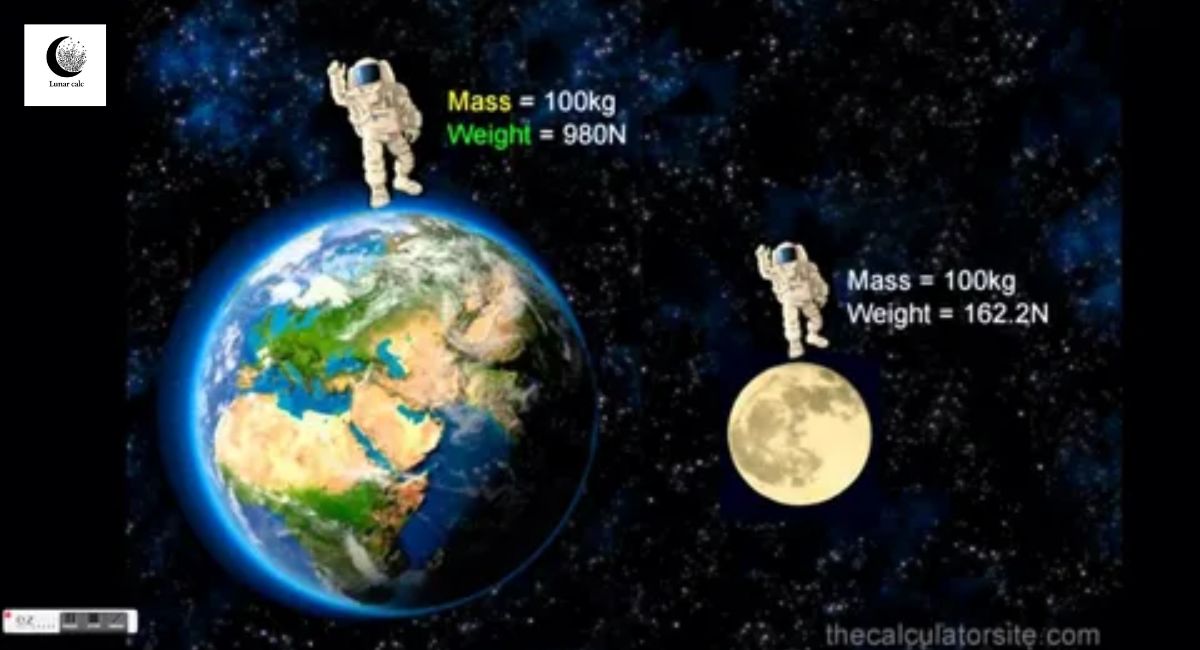
Before doing any calculations, it’s essential to understand two basic physics terms that people often mix up: mass and weight.
A Moon-weight calculator only works because these two things are not the same at all.
What Is Mass?
Mass is the amount of physical matter inside your body.
It never changes, no matter where you go.
- Your mass stays the same on Earth, the Moon, Mars—even in deep space.
- If your mass is 70 kg on Earth, it’s still 70 kg on the Moon.
What Is Weight?
Weight is the force with which gravity pulls your mass downward.
- Weight changes depending on the gravity of the planet or moon you’re standing on.
- Weight is measured in Newtons (N) or commonly expressed in lbs or kgf.
The formula for weight comes from Newton’s Second Law:
W=m×gW = m \times gW=m×g
Since your mass (m) never changes, only gravity (g) affects your weight.
Why the Moon Only Has 1/6 of Earth’s Gravity
A Moon weight calculator uses a simple fact: the Moon’s gravitational acceleration is much lower than Earth’s.
Why Is Moon Gravity So Weak?
Two reasons:
- Its radius is much smaller, bringing you closer to its center but still not enough to match Earth’s stronger gravity.
When scientists compare both gravitational values, they find:
- Earth gravity: 9.8 m/s²
- Moon gravity: 1.625 m/s²
Dividing these gives:
1.6259.8≈0.165\frac{1.625}{9.8} \approx 0.1659.81.625≈0.165
This means the Moon’s gravity is about 16.5% of Earth’s, commonly rounded to 1/6.
Comparison Table: Earth vs. Moon
| Metric | Earth | Moon | Difference |
| Gravitational Acceleration | 9.8 m/s² | 1.625 m/s² | Moon is 83.5% weaker |
| Weight Ratio | 100% | 16.5% | Moon weight = Earth weight ÷ 6 |
| Example Weight (180 lbs) | 180 lbs | 30 lbs | 150 lbs lighter |
| Mass Example (80 kg) | 80 kg | 80 kg | Mass stays same |
How a Weight on the Moon Calculator Works
There are two ways to compute lunar weight:
a fast method for regular users and a scientific method used by engineers.
Method 1: Simple 1/6 Rule (Easy & Common)
- Take your Earth weight.
- Divide by 6 (or multiply by 0.165).
Formula:
Moon Weight=Earth Weight6\text{Moon Weight} = \frac{\text{Earth Weight}}{6}Moon Weight=6Earth Weight
Example:
Earth weight = 180 lbs
Moon weight = 30 lbs
Method 2: Physics Method (Using Newtons)
- Convert your Earth weight to mass (kg).
- Multiply by the Moon’s gravity (1.625 m/s²).
Moon Weight (N)=Mass×1.625\text{Moon Weight (N)} = \text{Mass} \times 1.625Moon Weight (N)=Mass×1.625
Example:
Mass = 80 kg
Moon Weight = 80 × 1.625 = 130 N
Your mass stays 80 kg, but the force acting on you changes drastically.
Real-World Uses of Moon Weight Calculations
Moon-weight calculations are essential for designing lunar missions.
1. Designing Lunar Rovers
- Rovers must be heavy enough to maintain grip.
- But since weight is low, wheels need wide treads for traction.
- Low gravity makes slipping and skidding common.
2. Building Lunar Habitats
- Materials still have high mass, but their weight is low.
- Heavy shields and equipment become easier to lift and position.
- Robots or astronauts can move objects that would be impossible on Earth.
3. Astronaut Training
- Astronauts practice in harness systems that mimic Moon gravity.
- They must learn to move with a bouncing, energy-efficient gait.
- Exercise gear must create resistance without relying on gravity.
What 1/6 Weight Actually Feels Like
Jumping Ability
On the Moon, you can jump about six times higher.
A 1-foot jump on Earth becomes 6 feet on the Moon.
Running & Balance
- Running becomes unstable because friction is reduced.
- Astronauts use a slow, hopping walk to stay balanced.
Lifting Objects
You can lift much heavier items simply because they weigh less.
A 300-lb object feels like 50 lbs to your muscles.
Conclusion: The Universe’s Best Weight Discount
The weight-on-the-Moon calculator reveals a simple truth:
your mass never changes, but your weight depends entirely on gravity.
On the Moon, you instantly become six times lighter, even though you haven’t lost a single gram of mass. This small calculator demonstrates one of the most exciting realities of space exploration—the environment you’re in completely changes the force pulling you downward.
So the next time you’re feeling heavy, remember:
on the Moon, you’re almost weightless compared to Earth!
Frequently Asked Questions
Q: Why do astronauts wear heavy suits if Moon gravity is so low?
A: Their suits are massive because they contain full life-support systems. But on the Moon, their weight is greatly reduced—about 1/6 of their Earth weight—so they become easier to move in.
Q: Does gravity change at different places on the Moon?
A: Yes, slightly. Areas with dense underground rock (“mascons”) create small gravity variations, but the difference is tiny and doesn’t affect normal calculations.
Q: Will a regular bathroom scale work on the Moon?
A: Yes. It will show correctly that you weigh 1/6 of your Earth weight because it measures downward force, not mass.
Q: Is my mass different on the Moon?
A: No. Your mass is always the same everywhere in the universe.
Q: Does the Moon affect my weight on Earth?
A: Very slightly. The Moon creates tiny tidal forces that make you a few micrograms lighter when it’s overhead, but the effect is too small to notice.